


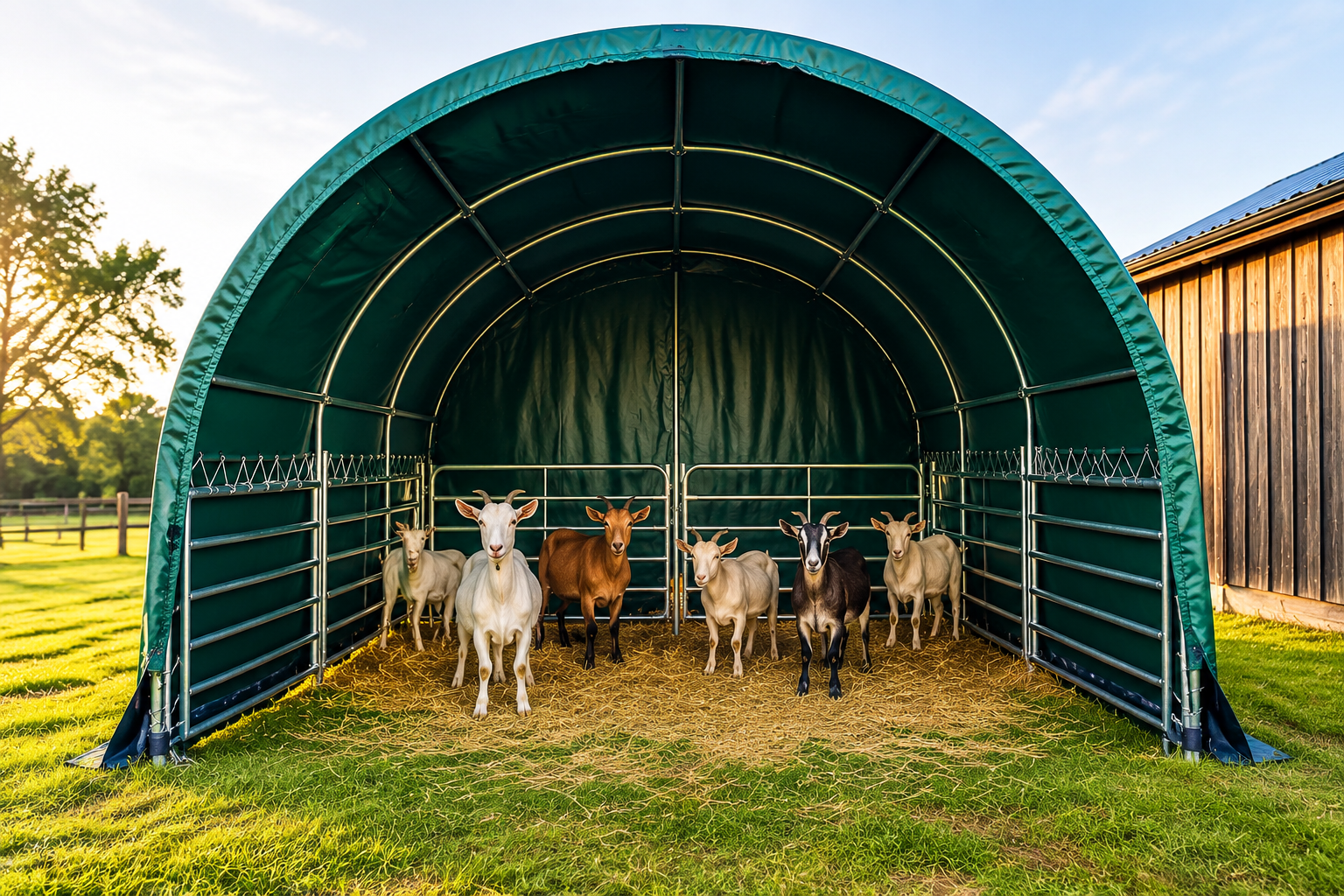
Portable Goat Shelter vs Traditional Barn is an increasingly important consideration for modern farmers looking for durable, flexible, and cost-effective livestock housing solutions.
Modern livestock farming is changing rapidly. Across North America, farmers and ranchers face rising construction costs, unpredictable weather, labor shortages, and increasing pressure to improve efficiency while maintaining animal welfare.
For decades, traditional wooden barns were considered the standard solution for housing goats and livestock. Today, however, many farmers are turning to a more flexible alternative: the portable livestock shelter.
Built with galvanized steel frames and durable PVC fabric covers, modern portable goat shelters provide weather protection, mobility, lower maintenance, and year-round adaptability for farms of all sizes.
But which option is actually better for your operation?
This guide compares portable goat shelters vs traditional barns in terms of cost, durability, flexibility, animal comfort, maintenance, and long-term farm efficiency.
Why More Farmers Are Reconsidering Traditional Barns
Traditional barns have long been valued for their durability and permanent structure. They can provide excellent protection during winter and create stable housing environments for livestock.
However, modern farming operations now require much more flexibility than they did decades ago.
Many farmers today practice:
- Rotational grazing
- Seasonal herd expansion
- Temporary pasture management
- Multi-species livestock farming
- Flexible land usage
Permanent barns often struggle to adapt to these changing needs.
In many cases, traditional barns involve:
- High construction costs
- Concrete foundations
- Long installation times
- Permit requirements
- Limited mobility
- Expensive maintenance over time
For small and medium-sized farms especially, these limitations can significantly reduce operational flexibility.
What Is a Portable Goat Shelter?
A portable goat shelter is a modular livestock structure designed for mobility, fast installation, and year-round animal protection.
Most modern portable shelters use:
- Hot-dip galvanized steel frames
- Heavy-duty PVC fabric covers
- Modular clear-span designs
- Anchoring systems for wind resistance
- Roll-up ventilation panels
Unlike permanent barns, portable shelters can be installed directly on pasture land without major site preparation.
They can also be relocated, expanded, or reconfigured as farm needs change.
Portable Goat Shelter vs Traditional Barn: Key Differences
1. Installation and Construction Costs
Traditional Barn
Building a traditional barn typically requires:
- Excavation
- Concrete foundations
- Framing
- Roofing
- Insulation
- Electrical systems
Construction may take weeks or even months depending on size and weather conditions.
Costs can quickly increase due to labor, permits, and materials.
Portable Goat Shelter
Portable livestock shelters are designed for fast assembly.
Most galvanized steel and PVC fabric shelters can be installed with basic tools and a small crew.
Key advantages include:
- No permanent foundation required
- Lower labor costs
- Faster setup
- Reduced permitting requirements in some regions
- Easier expansion later
For many farms, portable shelters offer a much lower upfront investment.
2. Flexibility and Mobility
One of the biggest advantages of portable goat shelters is flexibility.
Traditional barns remain fixed in one location permanently.
Portable shelters, however, can be:
- Moved between pastures
- Repositioned seasonally
- Expanded with modular sections
- Used for temporary or emergency housing
This flexibility is especially valuable for:
- Rotational grazing systems
- Seasonal kidding operations
- Temporary quarantine areas
- Multi-pasture farms
Modern livestock management increasingly favors adaptable infrastructure rather than fixed structures.
3. Durability in Harsh Weather
Many farmers assume permanent barns are automatically stronger than fabric livestock shelters.
In reality, modern portable shelters are engineered specifically for harsh weather performance.
Galvanized Steel Frame Advantages
High-quality portable shelters use hot-dip galvanized steel tubing that provides:
- Excellent corrosion resistance
- Strong snow-load performance
- Wind resistance
- Long-term structural durability
Unlike wood, galvanized steel does not:
- Rot
- Warp
- Crack
- Attract insects or termites
This significantly reduces long-term maintenance.
PVC Fabric Performance
Heavy-duty PVC fabric covers are designed to withstand:
- Rain
- Snow
- UV exposure
- Strong winds
- Temperature fluctuations
Properly tensioned PVC roofs also help snow slide off naturally, reducing roof stress during winter.
Premium PVC fabric commonly ranges from 610–900 g/m², depending on climate requirements and shelter size.
4. Animal Comfort and Welfare
Animal health depends heavily on proper ventilation, dryness, and environmental stability.
Poorly ventilated traditional barns can trap:
- Moisture
- Odors
- Ammonia
- Heat during summer
Modern portable livestock shelters are often designed with adjustable airflow systems such as:
- Roll-up side walls
- Open-front configurations
- Natural ventilation layouts
- Adjustable rear panels
This helps improve:
- Air circulation
- Temperature regulation
- Bedding dryness
- Respiratory health
For goats especially, dry and well-ventilated environments are essential during both winter and summer.
5. Maintenance Requirements
Traditional Barn Maintenance
Wooden barns often require ongoing maintenance such as:
- Roof repairs
- Painting or sealing
- Rot replacement
- Pest control
- Structural inspections
Over time, maintenance costs can become substantial.
Portable Shelter Maintenance
Portable livestock shelters generally require far less upkeep.
Galvanized steel frames resist corrosion, while PVC covers can usually be cleaned with low-pressure washing.
Routine maintenance mainly includes:
- Checking anchors
- Inspecting fabric tension
- Cleaning debris or snow buildup
This makes portable shelters particularly attractive for farms seeking lower long-term operating costs.
6. Space Efficiency and Interior Design
Many portable livestock shelters use a clear-span structure, meaning there are no interior support posts.
This creates several advantages:
- More usable floor space
- Easier feeding access
- Better livestock movement
- Faster cleaning
- Simplified equipment storage
Traditional barns often lose usable interior space due to support beams and structural divisions.
For feeding, bedding, and herd management, open interior layouts can significantly improve workflow efficiency.
7. Seasonal and Multi-Purpose Use
Portable livestock shelters are highly versatile.
In addition to goat housing, they can be used for:
- Hay storage
- Feed protection
- Equipment storage
- Temporary calving or kidding areas
- Sheep housing
- Horse shelters
- Cattle shade structures
This multi-purpose functionality increases overall return on investment.
Which Option Is Better for Small Farms?
For many small and medium-sized farms, portable goat shelters provide a more practical solution than traditional barns.
They offer:
- Lower startup costs
- Easier expansion
- Greater mobility
- Faster installation
- Lower maintenance
- Better adaptability to changing farm conditions
Traditional barns may still be suitable for:
- Very large permanent operations
- Cold-climate insulated facilities
- Specialized breeding systems
However, for flexible modern farming operations, portable shelters often provide a better balance between cost, efficiency, and performance.
Why Galvanized Steel + PVC Shelters Are Growing in Popularity
Across North America, more farmers are investing in modern livestock shelters because they combine:
- Structural durability
- Weather resistance
- Mobility
- Scalability
- Animal comfort
- Operational efficiency
The combination of galvanized steel frames and heavy-duty PVC covers creates a practical solution for farms facing increasingly unpredictable weather conditions.
These shelters are especially effective for:
- Snow protection
- Wind resistance
- Summer ventilation
- Rotational grazing systems
- Seasonal livestock management
As climate conditions continue to change, flexible livestock infrastructure is becoming more important than ever.
Final Verdict: Portable Goat Shelter or Traditional Barn?
The best solution ultimately depends on your farm’s size, climate, budget, and management style.
Choose a Traditional Barn if you need:
- Permanent infrastructure
- Fully insulated housing
- Large-scale fixed operations
Choose a Portable Goat Shelter if you want:
- Flexibility
- Lower construction costs
- Fast installation
- Mobility
- Lower maintenance
- Strong weather resistance
- Multi-purpose functionality
For many modern farms, portable livestock shelters now provide the most practical and cost-effective balance between protection, efficiency, and long-term value.
FAQ
Are portable goat shelters durable enough for winter?
Yes. High-quality shelters with galvanized steel frames and tensioned PVC fabric are designed to handle snow loads, strong winds, and cold temperatures.
How long does a portable livestock shelter last?
With proper maintenance, galvanized steel frames can last for many years, while premium PVC covers offer long-term weather resistance and UV protection.
Can portable shelters be moved easily?
Yes. Most modular livestock shelters are designed for relocation and expansion, making them ideal for rotational grazing and seasonal farm layouts.
Are portable shelters suitable for animals other than goats?
Absolutely. Portable livestock shelters are commonly used for sheep, cattle, horses, alpacas, and hay storage.

 EN
 ES
 FR
 PT
 DE
 IT
 RU
 JA